The hardest part of any trade or bet is the exit, and loss aversion, the disposition effect, anchoring, and the gambler’s fallacy are what quietly turn a clean cash-out into a costly one.
Everyone obsesses over the entry. Which coin, which level, which candle, the perfect second to get in. Then they freeze on the part that actually decides the outcome: getting out. The exit is where a green position quietly turns red, where a winning trade gives half its profit back, where a player who was up walks away with nothing. Buying is a single decision. Selling is a running argument with yourself that never quite ends, because the price can always go higher and the regret can cut both ways. A trader and someone tapping through a fast game are wrestling the same demon: a number climbing on the screen, and one finger hovering over the button that locks it in.
Why the exit is harder than the entry in online games and crypto
The entry has a clean trigger. You wait for your setup, you act, done. The exit offers no such mercy. There is no line on the chart that screams enough, because above every price sits a higher one you can imagine, and the mind treats that imaginary gain as something already owed to you.
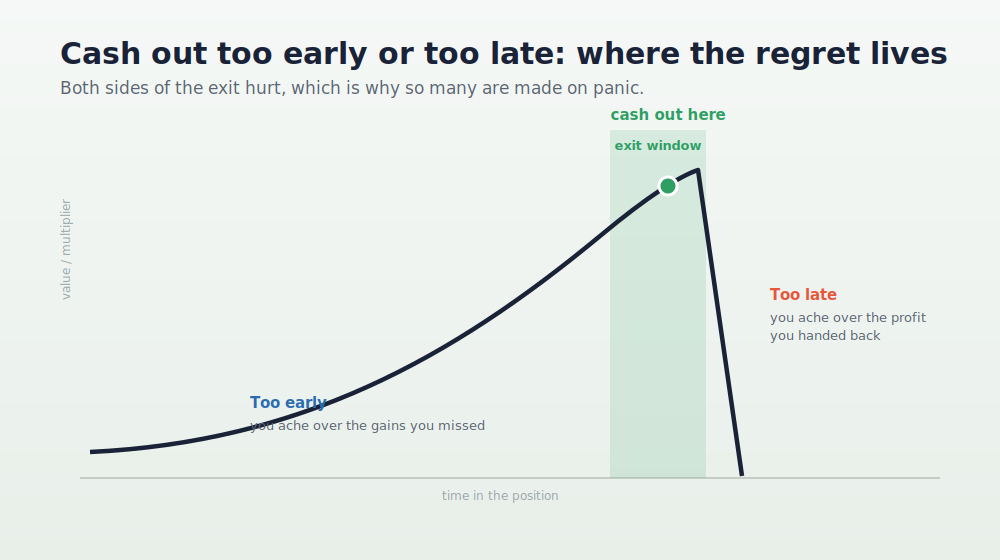
Leave early and you ache over the move you missed.
Leave late and you ache over the profit you handed back.
Both directions hurt, which is why so many exits get made by panic instead of plan. The cleanest way to feel that squeeze without risking a cent is the chicken road demo, a free browser version of the crash game where a cartoon chicken crosses a busy road one lane at a time.
Every lane it survives bumps the multiplier higher, and one careless step ends the round and wipes the lot.
The whole game is a single decision repeated over and over: cash out now and keep the multiplier, or push for one more lane.
Because the demo runs on no real money, it strips the exit down to the one thing that actually matters – the feeling – and that feeling is identical to the one a trader fights when a green candle keeps climbing and the plan starts to feel optional.
So we ran our own little experiment: hours in the demo, one question on repeat – at what point does “one more lane” stop being a plan and start being a trap. And as silly as it sounds, the thing began to work like a flight simulator for crypto traders. The multiplier on the screen never gave the answer; the answer was always a feeling, the exact moment the win starts to feel owned – and learning to catch that moment in the game is learning to catch it when it’s your own money on the line.
Leave too early and you regret the gains you missed; leave too late and you regret the profit you gave back.
The biases that hijack the cash-out in online games
Several well-documented quirks of the human mind gang up on the exit, and naming them is the first step toward spotting them in real time. Loss aversion, the centerpiece of prospect theory, means a loss stings roughly twice as hard as an equal gain feels good, so booking a small win can feel oddly worse than gambling it. The disposition effect pushes people to sell winners far too early and cling to losers far too long, the exact reverse of what the math wants. Anchoring glues attention to a number that already slipped past, a peak price or a multiplier you watched tick by, and turns it into a target you now chase. Then comes the gambler’s fallacy, the false hunch that a streak is owed a reversal, which talks people into one more round that probability never promised.
The same biases at a glance:
|
Bias |
What it does |
How it shows up at the exit |
|
Loss aversion |
A loss hurts about twice as much as an equal gain feels good. |
Booking a small, certain win feels worse than gambling it, so the position gets held too long. |
|
Disposition effect |
Pushes you to sell winners early and cling to losers. |
Profits get snapped up fast while red positions are nursed toward breakeven. |
|
Anchoring |
Fixes attention on a number that already slipped past. |
A past peak price or multiplier becomes the target you chase back to. |
|
Gambler’s fallacy |
The false sense that a streak is owed a reversal. |
One more round or one more candle, because a turn feels due. |
The disposition effect in one line
Strip away the academic phrasing and the disposition effect says something almost embarrassing: people would rather be right than rich. Selling a winner books a gain and confirms a smart call, so the brain grabs that little hit of validation early. Selling a loser forces an admission that the call was wrong, so the position gets nursed in the hope it crawls back to breakeven. The result is a portfolio, or a session, stuffed with the things that should have been cut and stripped of the things that should have been ridden. The same reflex fires the instant a player tries to lock in a modest multiplier and hesitates, suddenly certain the run still owes them more than it has paid.
What online games and the crypto exit have in common
Put a Chicken Road round next to a crypto exit and the overlap is hard to miss. Both stick a rising number in front of you, both leave the ceiling open, and both hand you a single lever that freezes the result the instant you pull it. That shared shape is why a few minutes in the demo can teach a trader more about their own nerve than another hour of chart theory: the chicken climbing through lanes is just a take-profit decision with the math stripped naked. The pattern our own sessions kept exposing was easy to name and hard to obey, the instant a win started to feel owned the right exit was usually already one lane behind us, and the only thing that reliably beat the urge was a number picked before the round rather than during it. That lesson does not stay inside the game. The same pre-set, feeling-proof exit is exactly what protects a crypto position when the candle is green and every part of you wants one more tick. One honest difference deserves to be said out loud, though. A crash game is built with a house edge, so its expected value sits below zero and the odds lean against the player over the long run, which parks it firmly in the entertainment column, never the income column. A real trading edge, when it truly exists, can flip that sign. The feeling at the exit is identical in both arenas; the underlying odds are not, and forgetting that is how people lose money they meant to keep.
A cash-out plan for online games you can actually follow
Discipline is not a personality trait you either have or lack; it is a stack of decisions made in advance, while the mind is still calm. The whole point of a plan is to delete the in-the-moment choice, because the in-the-moment choice is the precise one the biases have already rigged. Decide the exit before the entry, write it down, and treat the written version as the boss of the version that panics. None of this is glamorous, and that is the feature, not the flaw. A free demo like Chicken Road is a cheap place to rehearse the mechanics until pulling the trigger on time stops feeling like a fight, so the habits below are worth drilling there first:
- Set the exit before you enter, both a target where you take profit and a level where you admit the idea failed.
- Scale out in pieces instead of staking everything on one perfect top, so a single greedy second cannot undo the whole position.
- Write the plan down, since a rule you can see is far harder to argue with than a rule you only felt.
- Keep a short log of your exits and read it back, because the pattern of your own mistakes is the cheapest coaching you will ever get.
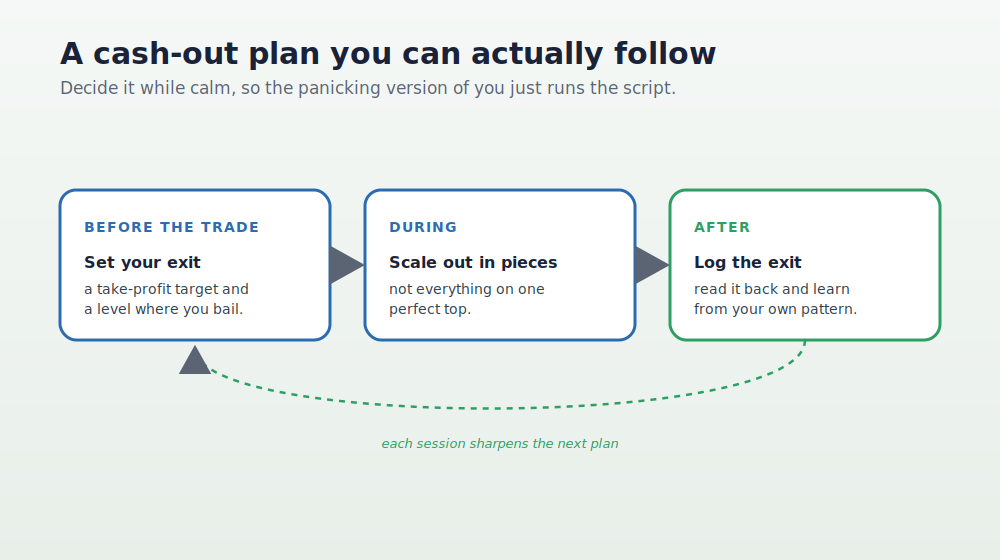
A simple loop: set the exit before the entry, scale out during, and log the result to sharpen the next plan.
The exit is a skill, not a feeling
The traders and players who keep their gains are rarely the boldest in the room. They are the most boring. They have turned the exit into a procedure dull enough that emotion barely gets a vote, because they learned the hard way that feeling is a tax the market and the game both collect. A calm, mechanical cash-out will sometimes leave money on the table, and that is fine; it also keeps the catastrophic round, the one that gives everything back, off the books. Hold one line in mind through all of it. In a game built with a house edge, the only real win is treating it as paid entertainment and stepping away when the fun ends. In trading, a true edge paired with the discipline to exit on plan is what survives the long run, and the exit is the half most people never bother to practice.