In 2025, comparison posts had a habit of crowning a single winner. One platform was “real-time.” Another was “cinematic.” A third was “good enough if you are new.” The tables looked decisive. Then people tried to ship a campaign.
This is a review of what still matters in 2026, written from the production side rather than from homepage adjectives. It is not a sequel that anoints a new perfect model. The useful split is still the same: a model generates a clip; a suite lets you iterate on a timeline; a desk remembers the shot list. Mixing those rows is how last year’s charts aged badly.
I watched the usual names through the same unglamorous brief: a 15–25 second product or scene that has to keep a face, a room, or a UI honest, then survive a mute test and a brand review. Spectacle demos were ignored on purpose.
What 2025 lists quietly assumed
Most “comprehensive comparisons” assumed you wanted:
- the prettiest eight seconds
- a platform that also storyboards, collabs, and pitches
- one SKU that replaces the editor
Real jobs split. A physicist-heavy car insert is not a SaaS walkthrough. A 60-second atmospheric establishing shot is not a 20-second CTA hold. Character “consistency” on a spec sheet is not the same as the same jacket at second eighteen.
If a review cannot say what it would not use the tool for, it is a brochure.
Sora-class: still the atmospheric reel, still a poor weekly printer
OpenAI’s Sora line (and the cinematic text-to-video cousins that copied its reputation) still earns the “this looks like a trailer” reaction. Lighting, weather, and camera grammar can feel directed in a way cheaper motion models do not.
Where it holds up: mood pieces, world-building, the one hero open you will actually color-grade.
Where it fails the brief: you rarely get a fat, labeled reference kit and a timed 0–6 / 6–16 / 16–24 structure as the default grammar. Access, queue time, and “I cannot lock this SKU” still show up in team Slack. Use it as second unit. Do not bet a catalog of 40 SKUs on it.
Veo-class: physics when the shot is the stunt
Google’s Veo-class models remain the lane I would open for action that has to obey weight: vehicles, sports, anything that looks fake if the mass is wrong.
Holds up: one hard insert.
Fails: a whole launch film. You will still cut. You will still need a product-true middle. Physics-first is not identity-first.
Kling-class: commercial motion, short leash
Kling-class photoreal motion is what a lot of paid social still wants: expensive-looking five to eight seconds, laptop on a table, city glass, a slow push.
Holds up: B-roll that never has to be your UI.
Fails: a navbar that must match Figma. Photoreal is not product-true. Pair it with a longer, reference-locked pass if the campaign has a real object.
Runway-class: the suite that still feels like work
Runway (Gen-3 / Gen-4 era, whatever the badge says this quarter) is the tool I trust when the team already thinks in a timeline. Generate, drop, regenerate that shot, export to the NLE you actually finishing in.
Holds up: editors. Motion brushes. People who will assemble 30 seconds from several takes plus a screen capture.
Fails: founders who wanted one button. A pile of beautiful six-second clips with three sidebars is not a product video. It is an edit — sometimes the right edit.
The longer multimodal lane (where 2025 charts went quiet)
A gap those LTX-versus-Sora tables underplayed: clips that need to be 15–30 seconds and still look like the stills you attached.
That job is a model job, not a collaboration-suite job. One option teams actually run for it is Seedance 2.5, a multimodal generator for coherent clips up to about thirty seconds from text plus image, video, and audio references, with timing and storyboard-friendly direction. I am not hanging this review on it. It is simply the shape of the lane: kit in, seconds on the page, identity before “cinematic.”
If second eighteen grows a new collar, you do not need a hotter brand name. You need a cleaner folder.
A desk is not a fourth model
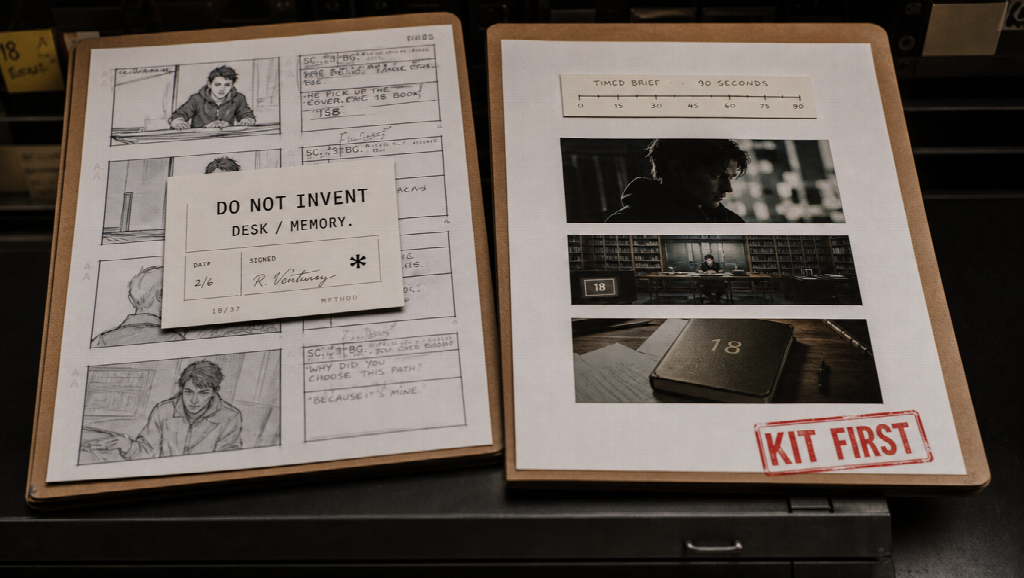
When Tuesday’s pickup story invents a new hallway, the failure was not “we picked Pika instead of Sora.” The failure was no shot list. A cinematic workspace — story, boards, camera notes, then generate — is a different purchase. Film Studio is one example of that desk on Topview: boards and performance notes first, scene generation after, while you stay in the director seat. Do not put it in a model scoreboard next to Veo. One remembers. One executes.
Field card (honest, not unlimited)
|
Lane |
What I would still use it for in 2026 |
What I would not |
|
Sora-class |
Atmospheric hero, longer cinematic texture |
Weekly SKU catalog |
|
Veo-class |
Weight, vehicles, sport inserts |
Identity-locked UI demo |
|
Kling-class |
Short photoreal B-roll |
Full product walkthrough |
|
Runway-class |
Generate + assemble on a timeline |
One-click brand film |
|
15–30s multimodal (e.g. Seedance 2.5) |
Timed beat with a real kit |
Six-minute movie in one render |
|
Story desk (e.g. Film Studio) |
Continuity before credits |
Competing with a diffusion model |
Anyone still advertising “unlimited length, real-time, perfect characters, cheaper than everyone” in one cell is selling 2025 brochure copy.
How I would actually buy
- Write the deliverable in seconds and aspect ratio.
- Circle whether the hero is mood, mass, your object, or a person talking.
- Pick the lane. Then pick a vendor inside the lane.
- If more than one shot has to match, buy memory (a desk or a ruthless kit folder) before you buy another model seat.
- Finish in an editor. Captions you meant. Music you own.
Verdict
The 2025 “perfect AI video model” article was answering a demo-reel question. The 2026 production question is narrower: which lane matches the clip you have to defend in a review meeting?
Sora-class still wins atmosphere. Veo-class still wins mass. Kling-class still wins short gloss. Runway-class still wins people who cut. The longer multimodal lane is for the 20-second proof that has to keep the still honest. A film desk is for the week the still has to come back.
There is no perfect row. There is a less embarrassing stack. That is the review.