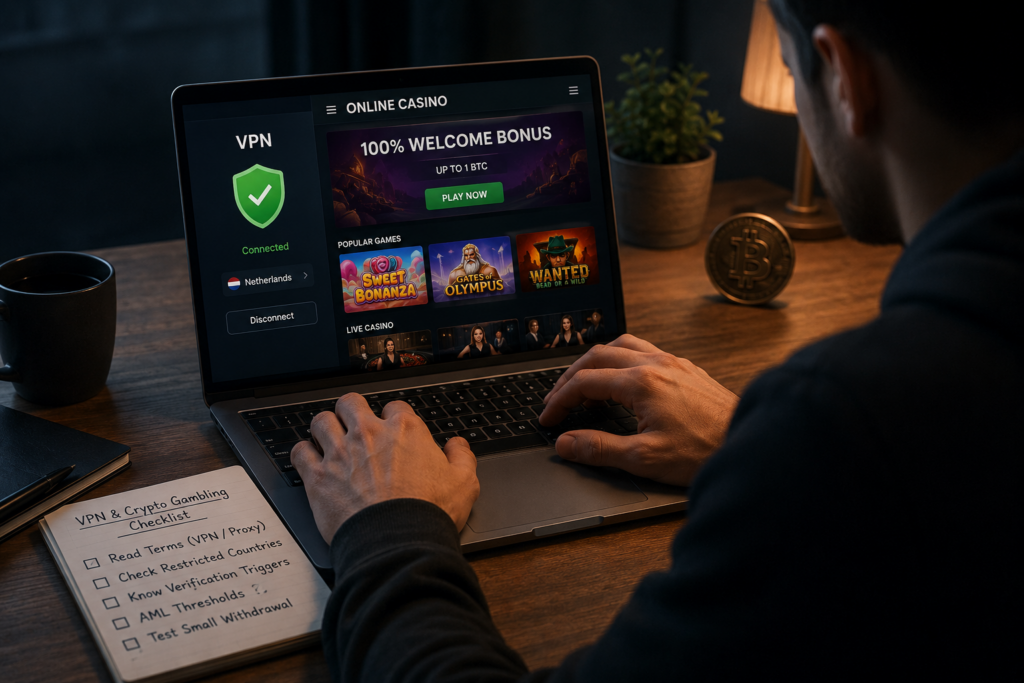
There are two entirely separate reasons a person connects to a VPN before opening a gambling site, and conflating them causes most of the bad outcomes in this space.
The first reason is privacy. You do not want your internet provider, your employer's network, or a hotel router logging which platforms you use. That is ordinary, defensible, and increasingly normal across every category of online activity.
The second reason is access. Your country is on an operator's restricted list and you want in anyway. That is a different proposition with a different risk profile, and no amount of encryption changes what happens when the operator works out where you actually are.
Most guidance published on this subject treats those as one topic. They are not.
What the terms usually say, and why the wording matters
Operator terms fall into three rough categories once you actually read them.
Some explicitly permit VPN use, or at least decline to mention it, which functionally amounts to the same thing in a dispute. Some prohibit it directly, using language about location masking, proxy services, or anonymising software. Some occupy a deliberate middle ground where nothing is banned outright but the operator reserves broad discretion to review, restrict, or void accounts for reasons it does not have to specify.
That third category is the dangerous one, and it is also the largest. A clause reading that the operator may request any documents at any time, or may suspend accounts where it suspects irregular activity, is not filler. It is the legal mechanism that permits a payout to be held indefinitely without the operator breaching its own terms.
A site loading successfully through a VPN tells you nothing about which category it belongs to. Access and permission are separate questions and only one of them is visible from the front page.
The distinction between friendly and tolerated
Worth being precise about this, because affiliate lists routinely collapse it.
VPN friendly means the terms permit it, or the operator has publicly confirmed it, and testing shows stable access including at withdrawal. You have something to point at if a dispute arises.
VPN tolerated means the site works and nothing in the terms prohibits it, but nothing protects you either. It functions until the operator decides it does not, and the decision point is almost always the moment your account becomes valuable.
VPN forbidden means the terms ban it. Some of these sites will still load through a VPN, which is precisely the trap. Access working is not permission granted.
Frameworks that grade operators on this properly tend to weight VPN policy and verification policy at roughly 40 percent each, with anti money laundering transparency taking the remaining 20. The resource at https://vpncasinos.net/ publishes its scoring model along those lines and separates tested access from stated policy, which is the distinction most competitor lists skip entirely.
Ambush verification is the specific failure mode to avoid
The pattern that costs players the most money works like this. A site markets itself as verification free or anonymous. Signup requires an email address and nothing else. Deposits process instantly. Play proceeds normally for days or weeks.
Then a withdrawal request goes in, and suddenly identity documents are required, proof of address is required, and proof of source of funds is required. Sometimes the connection history is cited as the reason for enhanced checks.
Nothing here is necessarily fraudulent. Anti money laundering obligations are real and operators do face them. The problem is sequencing. Verification demanded before money is deposited is a policy. Verification demanded after money is deposited and won is leverage, and the player has none of it at that point.
The fix is behavioural rather than technical. Deposit a small amount, play briefly, and request a withdrawal early, before your balance is worth defending. A first small payout is the cheapest information you will ever buy about an operator.
What actually gets checked besides your IP address
A common misunderstanding is that a VPN makes your location unknowable. It does not. It changes one signal among many, and operators fingerprint several.
Browser and device characteristics get logged. Time zone settings frequently contradict a claimed location. Language headers do the same. Payment rails carry geography of their own, and while crypto deposits are more neutral than cards, exchange withdrawal patterns and on chain history are not invisible. Session timing tells a story: an account claiming a European location that consistently plays at three in the morning local time is generating a flag whether or not anyone acts on it.
Shared VPN exit nodes create their own problem. A commercial VPN endpoint used by thousands of gambling accounts is a known address to risk teams, and traffic from it can attract scrutiny that a residential connection would not.
None of this means privacy tools are pointless. It means they are one layer rather than a cloak, and treating them as a cloak leads to decisions that do not survive contact with a compliance department.
The country restriction question, answered directly
Using a VPN to gamble from a jurisdiction an operator has blocked is a bad idea, and the reason is not moral.
Restricted country clauses void account terms. If you are detected, the standard outcome is account closure with balance confiscation, and the operator is acting entirely within its published rules. There is no regulator to appeal to, because you breached the agreement. Winnings become unrecoverable and there is no meaningful dispute path.
Operators do not typically detect this at deposit. They detect it during withdrawal review, when there is a balance worth examining. The sequencing is not accidental.
Privacy from a permitted region is a reasonable use case. Access from a blocked one is a bet with terrible terms, and the payoff is asymmetric in the wrong direction.
A short checklist before depositing anywhere
Read the terms for the words VPN, proxy, and location masking. Locate the restricted country list and confirm your actual jurisdiction is absent from it. Identify when verification is triggered, and if the site claims none is ever needed, treat that claim as unverified until you have tested a payout. Check whether anti money laundering thresholds are published as numbers or described in discretionary language, because published thresholds are a meaningfully better signal than vague ones.
Then test with an amount you would not mind losing entirely.
The uncomfortable summary is that privacy and getting paid are partially in tension in this sector, and the operators worth using are the ones that resolve that tension in writing rather than reserving the right to resolve it later, unilaterally, at the moment it costs you the most.