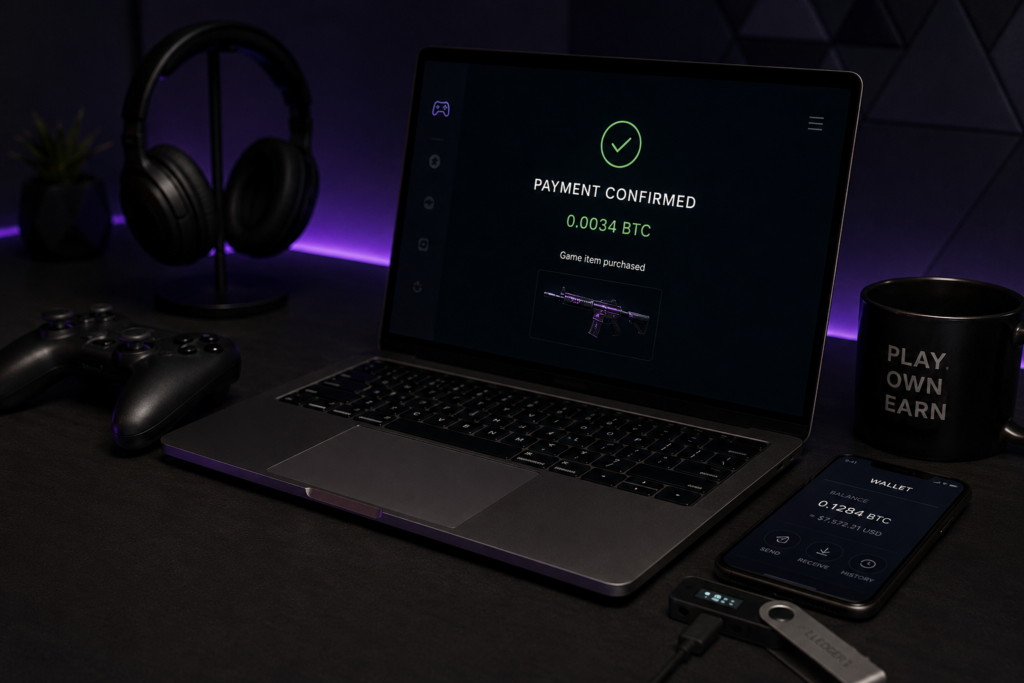
Cryptocurrency is changing online gaming most clearly at the cashier, not inside every game. A wallet can move value without a card network, stablecoins can reduce exposure to sharp price swings, and a public blockchain can provide a transaction record. None of that proves a game is fair or a platform is trustworthy.
Players still need to inspect licensing, identity checks, withdrawal rules, fees, and the mathematics behind each game. In 2026, the useful distinction is simple: a blockchain may carry the payment, while the operator still controls the account, game catalogue, customer checks, and payout process. That split explains both the appeal and the risk.
The payment rail moves first
Crypto deposits replace a chain of bank messages with a wallet transfer recorded on a distributed ledger. The practical gain is most noticeable when a conventional payment method is slow, unavailable, or expensive across borders. Settlement speed still depends on the asset, network congestion, the fee selected, and the number of confirmations an operator requires.
A transaction can also be unforgiving. Sending funds to the wrong address or choosing the wrong network may be irreversible, so a small test transfer is sensible before moving a larger amount. Players should copy addresses carefully, confirm the network on both sides, and keep a record of the transaction hash.
Stable value is not the same as stable access
Bitcoin and other freely traded assets can rise or fall between deposit and withdrawal. Stablecoins reduce that particular problem by tracking a reference asset, usually a fiat currency, yet they introduce issuer, reserve, de-pegging, and wallet risks. A displayed gaming balance may therefore hide two separate exposures: the result of play and the market value of the token.
Regulation is tightening around those flows. A 2026 FATF update reported that 83% of surveyed jurisdictions had passed legislation implementing the Travel Rule, up from 73% a year earlier. More compliance can mean extra source-of-funds questions, wallet screening, or delayed withdrawals rather than the anonymous, frictionless experience suggested by old crypto advertising.
Crypto meets the casino lobby
Crypto changes funding, yet slots still depend on game rules rather than the coin used to deposit. Return to player is a long-run theoretical percentage, and volatility describes whether prizes tend to arrive in smaller frequent amounts or larger rare ones. A reader assessing an online crypto casino should check the published RTP, provider, bonus wagering terms, and available spending controls before opening a game. A short session can finish far above or below the stated RTP because random results do not settle neatly over a handful of spins.
Licensed markets also require testing of random-number generators and continuing performance checks. The UK Gambling Commission explains that approved test houses review RNG documentation, source code, and statistical output. Blockchain payment records do not replace that work.
A public ledger does not make every game transparent
The phrase provably fair usually refers to a method that lets a player verify a result from cryptographic inputs after a round. It can make tampering easier to detect when implemented correctly. Most mainstream casino games, however, continue to run on conventional servers with certified RNGs, even if the cashier accepts crypto.
Players should ask four plain questions:
Transparency has layers. A visible transaction proves that funds moved; it does not prove that a bonus term is fair, an account will remain accessible, or a slot outcome was generated correctly.

Wallet security becomes part of account security
Crypto removes certain card details from the transaction, then adds a different set of hazards. Seed phrases, private keys, clipboard malware, fake support accounts, and approval scams all sit outside the gaming platform. Hardware wallets can protect long-term holdings, while a separate low-balance wallet can limit exposure during routine play.
Two-factor authentication should protect the gaming account and the email tied to it. Users also need a bookmarked login address, because a convincing copy of a payment page can capture credentials in seconds. No support agent needs a seed phrase or private key.
Odds, deposits and the sportsbook account
Sports betting funded with crypto still turns on the price offered for an uncertain event. The bettor must separate the stake’s token value from the probability implied by decimal odds; at 2.00, the break-even probability before margin is 50%. Someone reviewing Melbet betting should compare market rules, settlement terms, withdrawal verification, and the exchange rate applied when crypto enters or leaves the account. Faster funding cannot repair a poor price, a weak prediction, or a stake that exceeds the bettor’s limit.
That separation makes record-keeping useful. Log the token amount, fiat value at deposit, stake, odds, result, withdrawal value, and network fee. Profit in coins and profit in fiat are not always the same figure.
What a careful player checks before sending funds
The strongest 2026 habit is a slow first transaction. Confirm that the operator accepts the exact asset and network, read the minimum deposit and withdrawal amounts, and learn whether conversion happens automatically. Then check the license named on the site against the regulator’s own register and review the responsible-gaming tools available on the account.
Set a cash-equivalent entertainment budget before price movement changes the number on screen. Keep long-term holdings away from a gaming wallet, withdraw only to an address under your control, and never chase a loss because a token has moved against you. The technology can shorten the trip to the cashier. Judgment still decides whether to make it.