
Blockchain transactions cannot be reversed. The trail they leave behind is a different story — and it is the only thing standing between a victim and a total loss.
Lionsgate Intelligence Network. Supporting victims of financial fraud via cutting-edge forensics and law enforcement support.
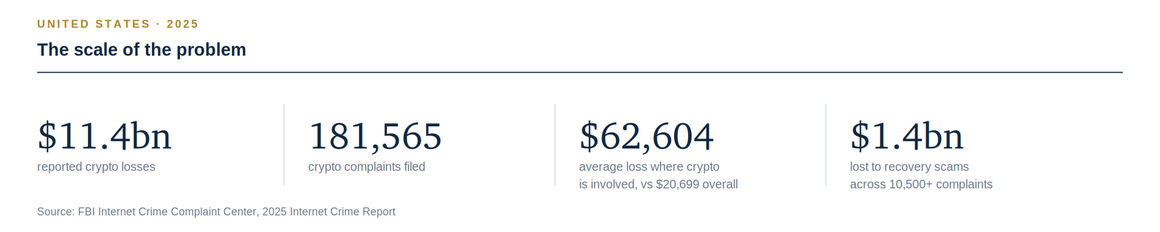
Americans reported more than $11.4 billion in cryptocurrency-related losses to the FBI’s Internet Crime Complaint Center in 2025 — over half of all internet crime losses recorded that year, across 181,565 complaints. The average loss across all reported internet crime was roughly $20,700. Where cryptocurrency was involved, it tripled, to about $62,600.
Behind each of those complaints is the same question, asked at the worst possible moment: is the money gone?
The honest answer depends on what happened after the theft, not during it. A blockchain transaction cannot be reversed — that part is settled. But it is also permanently recorded, which makes stolen cryptocurrency one of the few forms of stolen money that leaves a complete, timestamped, publicly verifiable trail. Crypto recovery is the discipline of reading that trail quickly enough, and precisely enough, for someone with legal authority to act on it.
What recovery actually involves
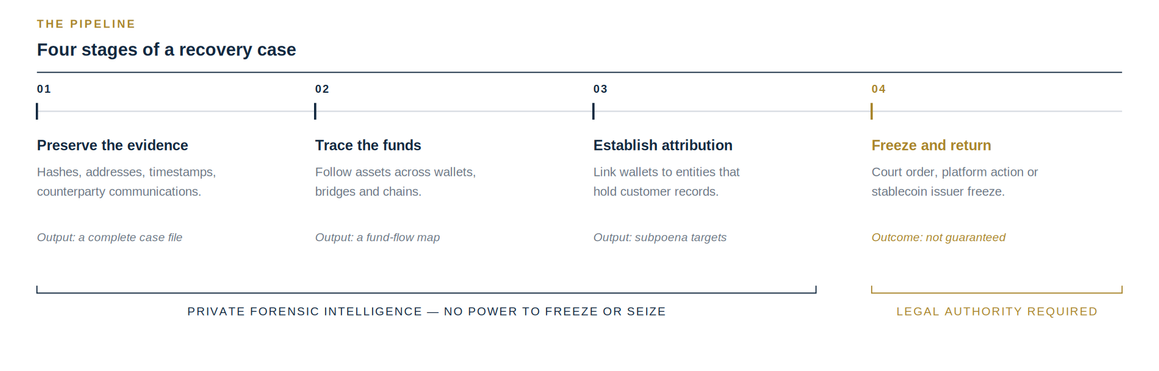
Recovery is not a single service. It has four distinct stages, and only the first three are within any private firm’s control. Confusing the two halves of that sequence is the most common — and most expensive — mistake victims make.
Stage 1: Preserve the evidence
The first hours matter more than most victims realise, and almost none of the work in them is technical. Transaction hashes, sending and receiving wallet addresses, exact timestamps, amounts, the network used, exchange records, and every message exchanged with the counterparty.
Fraudulent platforms are routinely taken offline within days of a victim raising an alarm. Chat histories vanish with them.
Stage 2: Trace the funds on-chain
Tracing runs forward from the point of theft, following assets across wallets and networks and mapping their contact with exchanges, bridges, payment processors and mixing services.
The distinction between this and a public block explorer is not cosmetic. An explorer shows that Wallet A sent funds to Wallet B. Forensic analysis asks what happened next, whether the pattern matches known laundering typologies, and whether any of it terminates somewhere a subpoena can reach.
It has become harder. Chainalysis reported that illicit addresses received at least $154 billion in 2025, with stablecoins accounting for the large majority of illicit transaction volume. Laundering has professionalised: specialist networks now absorb stolen assets in bulk, settle off-chain, and fragment funds across chains to break traceability before cash-out.
Stage 3: Identify the attribution points
Blockchain addresses are pseudonymous. An address alone proves nothing about the person controlling it.
Attribution becomes meaningful only when a wallet connects to something identifiable — a regulated exchange account, a payment processor, a named entity. Those platforms collect customer identity records under anti-money-laundering obligations, which makes an exchange touchpoint the single most valuable lead in most cases.
But no private investigator can telephone an exchange and request account details. What can be obtained, and by whom, is governed entirely by legal process and jurisdiction. This is where most cases either mature or quietly stall.
Stage 4: Determine whether a freeze is possible
If stolen funds reach an identifiable custodian and are still sitting there, timing becomes decisive. Authorities may have a narrow window to freeze the account, depending on jurisdiction and how quickly a credible evidentiary package reaches the right desk. Stablecoin issuers add a further lever: they retain the technical ability to freeze tokens at specific addresses.
What no private firm can do is freeze anything itself. Forensic intelligence establishes where the money went and assembles the evidence. Enforcement authority stays with the state.
How long does crypto recovery take?
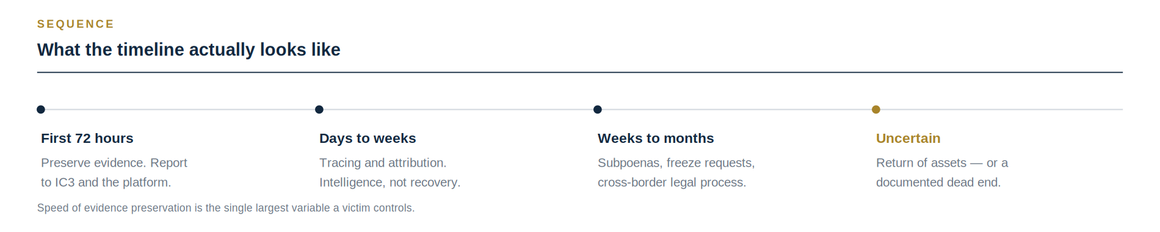
There is no fixed timeline, and any firm quoting one before reviewing a case is selling something. Tracing is the fast part — days to a few weeks with complete case information. That is intelligence, not recovery. The enforcement phase, where a viable path exists, is measured in months and controlled by courts, platforms and cross-border legal procedure.
How to identify a legitimate firm
People who have already lost cryptocurrency are among the most heavily targeted groups in fraud, because their loss is documented and their contact details often circulate on the same channels that facilitated the original theft. The FBI logged more than 10,500 recovery-fraud complaints in 2025, with an estimated $1.4 billion in losses. In some schemes, the fraudsters impersonated IC3 employees directly.
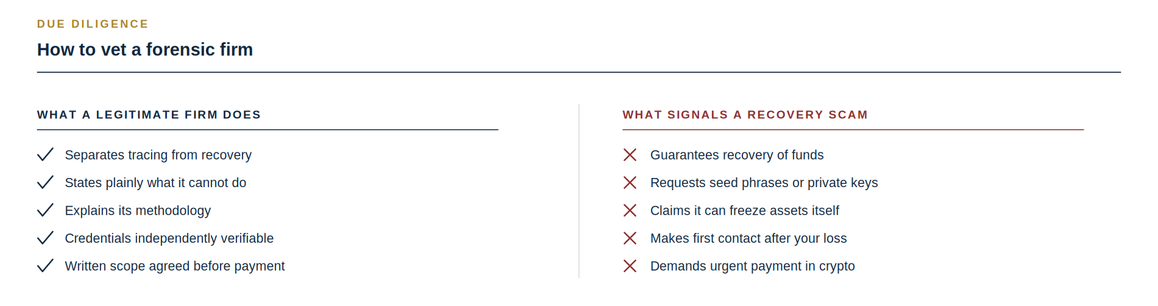
A credible forensic firm is identifiable largely by what it refuses to claim.
A firm built to that standard
Lionsgate Intelligence Network has analysed more than 7,000 cases since 2022 and traces over $1.5 billion in suspicious funds each month through its proprietary NEMESIS™ platform. Its credentials are verifiable rather than asserted: NATO NCAGE registration, active SAM.gov status, and a standing Law Enforcement Task Force that delivers evidentiary packages to the FBI, DHS/HSI, IRS-CI and the U.S. Secret Service.
That task force is led by Donna Gregory, who served 28 years with the FBI and was Unit Chief of the Internet Crime Complaint Center — the agency’s central intake point for internet crime, where she had worked since its inception in 2000.

The realistic bottom line
Crypto recovery is an evidentiary process with an uncertain outcome, and its value lies as much in producing a defensible answer as in producing a return.
Sometimes that answer is a traced path to a regulated exchange, an identified counterparty and a viable enforcement route. Sometimes it is a documented dead end at a mixing service — which is a genuine outcome, not a failure, because it ends the spending and, in several jurisdictions, supports a substantiated theft-loss position with tax authorities.
The failure mode is not learning the answer. It is paying a second time to avoid hearing it.
Frequently asked questions
Can stolen cryptocurrency actually be recovered?
Sometimes. It depends on whether the funds remain traceable, whether they reach an identifiable custodian, and whether an authority with jurisdiction acts before the assets move again. Speed of reporting is the largest factor a victim controls.
Can an investigator identify the person who stole my crypto?
Not from an address alone. Identification requires an evidenced link between a wallet and an account, entity or service — which in practice means a regulated platform’s records, obtained through legal process.
Should I trust a firm that guarantees recovery?
No. Outcomes depend on courts, exchanges and foreign authorities that no private firm controls. Guarantee language is the clearest single indicator of recovery fraud.
Why do serious forensic firms require an upfront fee?
Because the investigation starts immediately. The fee covers investigators, forensic tools, evidence preservation, reporting, and case support—not a promise of recovery.
Why choose Lionsgate Intelligence Network instead of just hiring a lawyer?
Because lawyers often need forensic specialists to find and document the assets. Lionsgate builds the intelligence and evidence the legal process can act on.
Why can’t law enforcement trace and recover the funds for me for free?
Law enforcement has limited resources and competing priorities. A legitimate crypto recovery company can develop the case, organize the evidence, and make it easier for authorities to evaluate and act.
What exactly am I paying Lionsgate Intelligence Network to do?
To move your case from inaction to action—trace the funds, identify wallets and endpoints, preserve the evidence, build an actionable forensic package, and support the law-enforcement process.