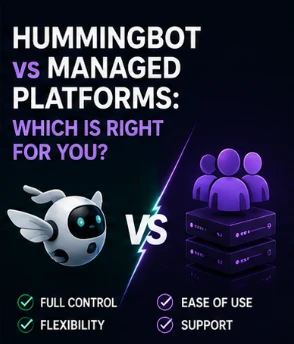
Hummingbot is one of the most well-known names in crypto trading automation — an open-source bot framework used by market makers, arbitrage traders, and quant developers. But it’s not for everyone. This guide breaks down who should use Hummingbot, who’s better served by a managed trading platform, and how to make the call.
What Is Hummingbot?
Hummingbot is a free, open-source crypto trading bot framework. You run it on your own infrastructure — local machine or cloud server — and configure strategies in code. It’s built around market-making strategies but supports arbitrage, liquidity mining, and custom algorithmic approaches.
Because it’s open-source and self-hosted, Hummingbot gives you complete control — and complete responsibility for everything.
What Are Managed Trading Platforms?
Managed platforms (like GoodCrypto, 3Commas, Bitsgap, and others) are cloud-hosted services where you connect your exchange via API and configure bots through a graphical interface — no code, no server management, no deployment pipeline.
You set parameters, the platform handles execution. Updates, uptime, and infrastructure are the platform’s problem, not yours.
Hummingbot: Strengths
Total Control
With Hummingbot, you can build exactly the strategy you want — custom logic, custom parameters, custom connectors. There’s no feature gatekeeping from a platform’s roadmap.
No Subscription Fees
The framework itself is free. Your cost is infrastructure (a cloud VM runs ~$5–20/month) and your time. For high-frequency or high-volume strategies, this can be significantly cheaper than a monthly SaaS fee.
Market-Making Capabilities
Hummingbot was built specifically for market making — placing limit orders on both sides of the order book to capture the spread. No managed platform offers this level of market-making sophistication out of the box.
Open-Source Transparency
You can read every line of code. For traders who are security-conscious or want to audit exactly what their bot is doing, this is a significant advantage.
Hummingbot: Weaknesses
Technical Barrier
Hummingbot requires comfort with command-line interfaces, Python configuration, and self-hosting. Setup alone can take hours for a non-developer. Ongoing maintenance (updates, bug fixes, exchange API changes) adds to the time cost.
No GUI
Configuration is done through YAML files and a text-based interface. There’s no visual dashboard, no drag-and-drop bot builder, no mobile app.
Uptime Is Your Responsibility
If your server goes down, your bots stop. Running your bot on reliable dedicated hosting can improve availability, but monitoring and recovery are still your responsibility.Managed platforms handle uptime as part of the service.
Support
Community support via Discord and GitHub. There’s no customer support team to contact when something breaks at 2am during a volatile market session.
Managed Platforms: Strengths
No Technical Setup Required
Connect your exchange API, configure a bot through a UI, and you’re running. The entire setup takes minutes, not hours.
Cloud-Hosted with Guaranteed Uptime
Your bots run on the platform’s infrastructure 24/7, regardless of whether your local machine is on. This matters for strategies that need to react instantly to market conditions.
Mobile Monitoring
Most managed platforms offer mobile apps for monitoring positions, adjusting settings, and closing trades — critical for active traders who aren’t always at a desk.
Built-In Risk Management Tools
Smart stop-losses, take-profit targets, trailing stops, and position size limits are configurable through the UI. No code required.
Managed Platforms: Weaknesses
Subscription Cost
Quality platforms charge $20–100+/month depending on features and plan tier. For low-volume traders, this can eat into profits.
Strategy Limitations
You’re constrained to what the platform offers. Custom algorithmic strategies or advanced market-making logic typically aren’t possible without developer-level API access.
API Key Dependency
Your exchange credentials are stored on a third-party server. Reputable platforms use encrypted storage and trade-only permissions, but the risk surface is wider than self-hosting.
Head-to-Head Comparison
Setup complexity:
Hummingbot: High (CLI, Python, server deployment). Managed platforms: Low (web UI, minutes to configure).
Cost:
Hummingbot: Infrastructure only (~$5-20/month). Managed platforms: $20-100+/month subscription.
Strategy flexibility:
Hummingbot: Unlimited (custom code). Managed platforms: Limited to available bot types.
Uptime responsibility:
Hummingbot: Yours. Managed platforms: Platform’s.
Mobile access:
Hummingbot: None. Managed platforms: Yes, dedicated apps.
Market making:
Hummingbot: Native, sophisticated. Managed platforms: Basic or unavailable.
Best for:
Hummingbot: Developers, quants, market makers. Managed platforms: Active traders, beginners, non-developers.
Which Should You Choose?
Choose Hummingbot if:
- You’re a developer comfortable with Python and self-hosting
- You need custom strategy logic that no platform offers
- You want to run market-making strategies seriously
- You’re cost-sensitive and can invest time instead of money
Choose a managed platform if:
- You want to automate trading without writing or maintaining code
- You need bots running 24/7 without managing infrastructure
- Mobile monitoring and management matter to you
- You want built-in risk management tools with a visual interface
For traders who want the power of automation without the technical overhead, a managed platform is the practical choice. If you’re evaluating the best hummingbot alternative for your needs, the right pick depends on how much you value control vs. convenience — and how much time you’re willing to invest in setup and maintenance.
FAQ
Is Hummingbot free?
Yes. The Hummingbot framework is open-source and free to use. Your only costs are cloud server hosting (typically $5–20/month) and any exchange trading fees.
Can Hummingbot run on a cloud server?
Yes. Hummingbot is commonly deployed on VPS providers like AWS, DigitalOcean, or Vultr. A low-spec Linux instance is sufficient for most strategies.
What exchanges does Hummingbot support?
Hummingbot supports a wide range of CEXs and DEXs including Binance, OKX, Bybit, Kraken, Gate.io, and several decentralized exchanges. The connector list grows with community contributions.
Do I need to know Python to use Hummingbot?
For basic pre-built strategies, minimal Python knowledge is needed. For custom strategy development, Python proficiency is required.
Bottom Line
Hummingbot and managed platforms aren’t competing for the same trader. Hummingbot is a toolkit for developers and quants who want maximum control and flexibility. Managed platforms are for active traders who want reliable automation without the infrastructure overhead.
Knowing which category you fall into makes the choice straightforward.