The global payments landscape has never moved faster. Between cross-border expansion, surging alternative payment methods, and ever-tightening fraud controls, businesses that rely on a single payment gateway are increasingly finding that their infrastructure is the single biggest bottleneck between a customer’s intent and a completed sale. In 2026, the answer that forward-looking merchants, fintechs, and payment service providers are converging on is the same: consolidate, optimize, and orchestrate.
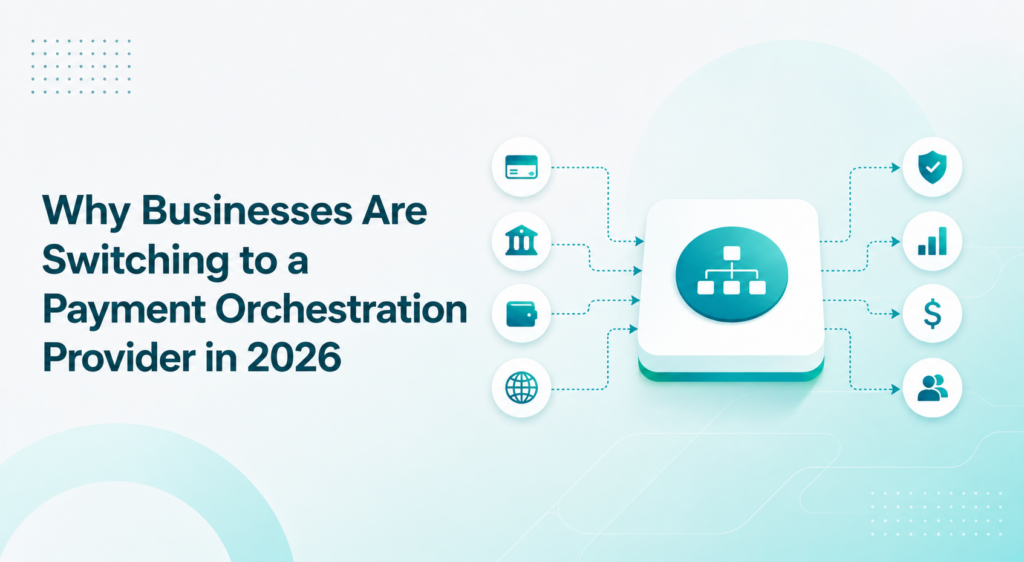
A payment orchestration provider sits above a company’s existing payment stack, intelligently routing every transaction to whichever processor, acquirer, or alternative payment method offers the best combination of approval rate, cost, and speed — at that moment, for that card, in that geography. It is not a replacement for payment gateways; it is the intelligent layer that makes every gateway underneath it work harder.
The migration wave toward orchestration is accelerating for reasons that go beyond convenience. Regulatory complexity is rising. Customer expectations for seamless checkout experiences have never been higher. And the days when a single acquiring relationship was “good enough” are over for virtually every business operating at scale. For those who are just starting out in the industry, understanding how to properly structure a credit card processing company from the ground up has become inseparable from understanding orchestration — because the two are increasingly built together, not bolted on afterward.
The Problem With Single-Provider Dependency
For years, the standard playbook was straightforward: pick a reputable payment gateway, negotiate a rate, integrate once, and move on. That model served well in a simpler era, but it has four compounding failure modes that are increasingly costly in 2026.
- Approval rate ceilings. Every acquirer has strengths and blind spots — certain card types, BINs, or geographies where their decline rates run high. With a single provider, there is no fallback.
- No negotiating leverage. Businesses locked into one processor have no competitive pressure to keep fees in check or service quality high.
- Catastrophic single points of failure. Downtime, bank outages, or sudden changes in an acquirer’s underwriting policy can halt revenue entirely, with no automatic rerouting.
- Inability to localize. Customers in Brazil, Southeast Asia, or the Middle East increasingly expect to pay with local methods — BOLETO, GrabPay, STC Pay — that a Western gateway simply cannot support natively.
Orchestration solves all four simultaneously, not sequentially. That is why it is no longer a “nice-to-have” for enterprise payments teams — it is becoming the baseline expectation.
What Payment Orchestration Actually Does
The term “orchestration” is sometimes misused to describe simple multi-gateway failover. True orchestration is considerably more sophisticated. At its core, a modern platform performs five distinct functions that compound on each other:
- Intelligent routing. Each transaction is analyzed in real time — card type, BIN, issuing country, transaction amount, merchant category, time of day — and directed to the provider statistically most likely to approve it at the lowest cost.
- Cascading failover. If the primary provider declines or times out, the transaction is silently retried through one or more alternative channels within the same checkout session, before the customer even sees an error.
- Tokenization and card data security. Sensitive card details are stored at the network level rather than by individual processors, reducing PCI DSS scope, enabling seamless recurring payments across providers, and supporting automatic card updates when cards are reissued.
- Unified fraud management. Rather than maintaining separate fraud rule sets for each acquirer, merchants configure a single engine — typically with 150 or more customizable filters — that applies consistently across every channel.
- Automated reconciliation. Transactions settled across a dozen providers are matched, reported, and reconciled automatically, eliminating the manual back-office burden that multi-provider setups traditionally create.
Payment Gateway vs. Payment Orchestration: A Side-by-Side Comparison
The distinction between a traditional gateway and an orchestration platform is not just technical — it is strategic. The comparison below captures the most consequential differences for businesses evaluating their infrastructure in 2026.
|
Capability |
Traditional Gateway |
Orchestration Platform |
|
Provider connections |
Single acquirer or limited set |
600+ banks, acquirers, APMs via one integration |
|
Routing logic |
Static or none |
Dynamic, real-time, rule-based or ML-driven |
|
Decline handling |
Transaction fails; customer retries manually |
Automatic cascading to backup providers |
|
Fraud management |
Provider-specific, limited customization |
Unified engine with 150+ configurable filters |
|
Reconciliation |
Manual per-provider exports |
Automated cross-provider matching |
|
New integrations |
Weeks to months per provider |
~14 days average for new connectors |
|
Currency support |
Limited to gateway’s scope |
200+ currencies including crypto |
|
Deployment options |
Typically SaaS only |
SaaS, On-Premise, or Cloud-Agnostic |
The Revenue Case: Approval Rates Are Revenue
The business case for orchestration often gets framed around cost reduction, but the more compelling argument is on the revenue side. Every declined transaction that could have been approved — through a different acquirer, a different routing path, or a cascading retry — is revenue that evaporates silently. It does not show up as a refund or a chargeback. It simply disappears from the funnel, often attributed to “customer abandonment” without further investigation.
Intelligent routing alone can lift approval rates by up to 30 percentage points on targeted transaction segments. For a merchant processing $50 million annually with a 5% decline rate, moving even half of those declines into approvals represents millions in recovered revenue — without acquiring a single new customer. The math is direct: orchestration pays for itself rapidly, and then compounds.
Processing cost optimization runs parallel. By routing transactions to the lowest-cost qualifying acquirer for each BIN range and geography, orchestration platforms can reduce blended processing fees by up to 30%. The two effects — higher approval rates and lower per-transaction costs — work simultaneously on opposite ends of the margin equation.
Why 2026 Is the Tipping Point
Several market forces have converged in 2026 to make orchestration migration more urgent than it was even two years ago.
- Alternative payment methods (APMs) have crossed the mainstream threshold. In many emerging markets, digital wallets and buy-now-pay-later products now account for the majority of e-commerce transactions. Single-gateway setups simply cannot serve these customers without significant additional integrations — each of which an orchestration platform absorbs as a standard connector.
- Fraud sophistication is outpacing static rule engines. Orchestration platforms built on decades of combined expertise adapt their fraud models continuously, rather than relying on quarterly rule updates from a single provider’s security team.
- Global expansion has become table stakes. Post-pandemic, businesses that were once domestic are now cross-border by default. Each new geography brings new local acquirers, payment regulations, and currency considerations — all of which an orchestration layer handles centrally.
- Enterprise buyers are demanding payment resilience. CFOs and CTOs who experienced revenue disruption from gateway outages or sudden policy changes now insist on multi-provider redundancy as a non-negotiable infrastructure requirement.
What to Look for in a Payment Orchestration Provider
Not all orchestration platforms are equivalent. When evaluating providers, businesses should assess the following dimensions carefully rather than relying on headline metrics alone.
- Depth of integrations. The number of connected providers matters, but so does their geographic and method diversity. A platform with 600 integrations weighted toward European acquirers will underperform for a business expanding into Latin America or Southeast Asia.
- Routing sophistication. Rule-based routing is a starting point; the best platforms combine static rules with dynamic optimization that learns from transaction outcomes over time.
- Deployment flexibility. SaaS is appropriate for most businesses, but heavily regulated industries or enterprise buyers with data sovereignty requirements may need on-premise or private cloud options.
- Speed to market. A platform that can add a new payment connector in 14 days gives businesses a meaningful competitive advantage when entering new markets.
- Support quality. A dedicated account manager — not a shared support queue — makes a measurable difference when routing configurations need to be tuned or a regional processor goes offline unexpectedly.
- Tokenization architecture. Ensure card data is stored at the network level with automatic updater functionality, so recurring billing and subscription models are not disrupted when customers receive replacement cards.
Real-World Impact: What Businesses Report After Switching
The most credible evidence for orchestration’s value comes not from benchmarks but from the businesses that have migrated. Across multiple deployment cases, a consistent pattern emerges: the transition is faster than expected, and the operational benefits extend well beyond the initial approval-rate headline.
Payment service providers report launching with fully operational routing, cascading, and fraud scoring infrastructure in weeks rather than months — a timeline that would have required twelve to eighteen months of internal engineering effort under a build-your-own model. Merchants migrating from legacy in-house platforms note that even complex migrations involving years of historical data, custom anti-fraud rules, and recurring billing relationships can be executed without revenue disruption when the orchestration provider actively manages the transition.
The operational simplification is equally significant. Having onboarding, risk rules, reconciliation, and real-time reporting in a single portal — rather than spread across the admin panels of multiple disconnected processors — reduces back-office headcount requirements and eliminates the error-prone manual matching that multi-provider settlements traditionally demand.
Conclusion: Orchestration Is Now Foundational Infrastructure
The question in 2026 is no longer whether payment orchestration is worth the investment. For any business processing transactions at meaningful volume, across multiple markets, or with ambitions to grow — the question is only which platform to choose and how quickly to migrate. The combination of higher approval rates, lower processing costs, built-in redundancy, and global coverage makes orchestration the most financially consequential infrastructure decision a payments team will make this year.
The businesses that act decisively will not only recover the cost of migration within months — they will compound those gains as their transaction volume grows, their geographic footprint expands, and the intelligence of their routing engine sharpens with each transaction processed. The window for treating this as a future project is closing. In the payments arms race of 2026, orchestration is the baseline — and the gap between those who have it and those who do not is already measurable in revenue.